
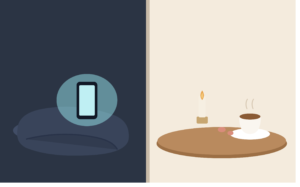
It has its own audio, its own aesthetic, its own multi-billion-view tag: bed rotting. Hours — sometimes days — spent horizontal, phone in hand, curtains drawn, nothing happening on purpose. It’s marketed as the ultimate act of self-care, the rebellion against hustle culture, permission to finally do nothing. And for a generation running on empty, the appeal is obvious.
But sleep researchers and mental health professionals have been watching the trend with growing concern. Nearly one in four Gen Zers now say they’ve spent multiple hours in bed at a stretch as a way of coping with stress. And the data on what that actually does isn’t reassuring — habitual bed rotting has been linked to more anxiety and depressive symptoms, not less, along with disrupted sleep patterns that make the exhaustion worse. Something that was supposed to feel like recovery is quietly compounding the problem.
Stillness isn’t the same as rest
Here’s the part that gets lost in the trend: your body doesn’t measure rest by how little you moved. It measures rest by whether your nervous system actually got the signal to stand down.
Lying still while scrolling keeps your brain in exactly the state bed rotting is supposed to escape — a low-grade, constant stream of notifications, comparison, and stimulation, just horizontal instead of upright. Your muscles may not be working, but your nervous system is still on alert, still processing, still waiting for the next ping. That’s why so many people report bed rotting for hours and standing up feeling more depleted than when they lay down. The body was never given permission to actually let go — it just stopped moving.
This is the distinction we build every ritual around at Ziva: the difference between collapsing and restoring. They can look similar from the outside — someone still, someone quiet — but physiologically, they are opposites.
What real restoration asks of the body
Genuine rest isn’t passive. It’s a state your nervous system has to be guided into, through signals it actually recognizes:
- A clear beginning and end. Bed rotting has no edges — it drifts, which is part of why it doesn’t register as “done.” A ritual has a start and a close, so your body knows when it’s safe to shift back out of rest mode.
- Touch, not screens. Scrolling keeps the nervous system scanning for input. Slow, intentional touch — like the foot and scalp work at the center of the Ziva Method — gives the body something calming to actually respond to, instead of something to keep monitoring.
- Sensory cues that say “stand down.” Warm tea, dim light, quiet, a defined space to step into — these are the signals that tell your nervous system it has permission to fully exhale, in a way four hours under a blanket with a phone glowing rarely does.
- A slow return, not a sudden one. Every Ziva ritual closes gradually on purpose, giving the body time to integrate the calm before you’re back on your feet. Bed rotting usually ends the opposite way — an alarm, a notification, a jolt back into motion.
Rest is worth protecting. It’s just not the same as shutting down.
The instinct behind bed rotting isn’t wrong — people are genuinely exhausted and reaching for permission to stop. That part deserves real support, not a lecture about screen time. But there’s a difference between a body that’s been allowed to actually rest and a body that’s just been left alone with its stress for a few more hours. One helps. The other tends to leave you right back where you started, just later in the day.
If your version of “resting” lately has looked more like disappearing than restoring, that’s usually a sign your nervous system needs something more active — not more effort, just more intentional.
Give your body a real reset. Book your ritual at our Arlington, VA studio, or ask about mobile visits if you’d rather have the ritual come to you. First-time guests get 10% off their first session.
Ziva Wellness · 2300 N Pershing Dr., 3rd Floor, Arlington, VA 22201 · 571-977-8393